De-risking Green Hydrogen and Ammonia Projects in Indonesia: A Risk-Based Approach to Innovative Climate Finance and Policy Design
Executive summary
“This proposal outlines a research initiative focused on De-risking Green Hydrogen and Ammonia Projects in Indonesia through a risk-based approach to innovative climate finance and policy design. The study addresses the significant challenge of mobilizing climate finance for industrial decarbonization, specifically tackling the investment and bankability hurdles faced by green hydrogen and green ammonia projects in Indonesia. Despite their potential to enhance global competitiveness and drive decarbonization, these projects often struggle to secure financing due to perceived high risks and uncertainties in their supply chains.
The primary objective of this research is to bridge the gap between technical viability and financial attractiveness by developing a systematic framework. Specifically, the study aims to:
Translate key supply-chain risks in green hydrogen and ammonia production into quantifiable, investment-relevant financial risk categories (e.g., capital expenditure escalation, revenue volatility, and debt service coverage ratios).Assess the comprehensive impact of these identified risks on project cost, revenue stability, and overall bankability.
Design innovative climate finance mechanisms to mitigate these risks within the Indonesian context.
Provide actionable policy recommendations for government agencies and financial stakeholders to foster an enabling environment for green hydrogen and ammonia investments.
The research employs an applied, mixed-method design, integrating qualitative risk assessment with quantitative financial analysis across four main stages:
Baseline Risk Identification: An initial inventory of 50 potential risks across economic, supply chain, technology, environmental, market, social, and regulatory categories will be established through a comprehensive literature review.
Multi-Stakeholder Risk Validation & Re-Ranking: These risks will be validated and prioritized using the Technique for Order Preference by Similarity to Ideal Solution (TOPSIS) method through structured consultations with government, industry, and financial experts. The top five priority risks will then be translated into investment-relevant financial risk categories.
Mapping to De-risking Financial Instruments: The identified top five risks will be systematically matched with appropriate de-risking financial instruments through a case study analysis, such as green ammonia production at PT Pupuk Iskandar Muda, and validated for applicability within Indonesia’s regulatory and market landscape using tools like HOMER Pro.
Public Consultation and Policy Synthesis: Findings will be discussed with diverse stakeholders, and feedback will be integrated to develop actionable policy and finance recommendations for accelerating green hydrogen and ammonia projects in Indonesia.
The expected outcomes are a comprehensive framework for mitigating risks and enhancing the financial viability of green hydrogen and ammonia initiatives, culminating in actionable policy and investment recommendations. This includes a prioritized list of supply chain risks, a precise alignment of these risks with suitable de-risking financial instruments, and a strategic roadmap for policymakers and investors. This roadmap will serve as a crucial guide to foster a robust and sustainable green hydrogen economy in Indonesia, accelerating industrial decarbonization and strengthening national energy security.
Furthermore, the study is committed to Gender Equality and Socio-Economic Inclusivity. This commitment is demonstrated by targeting at least 50% female representation within the research team and a minimum of 30% female participation in the expert panel for risk validation. A gender-focused method will be used to examine expert feedback to encourage equal access to funding and a fair sharing of benefits in Indonesia’s growing green ammonia industry.”
Objective
Translate key supply-chain risks into investment-relevant financial risk categories.
Assess the impact of these risks on project cost, revenue stability, and bankability.
Design innovative climate finance mechanisms tailored to green hydrogen and ammonia projects.
Provide actionable policy recommendations for government and financial stakeholders.
Team Composition
Sheila Tobing, S.T., M.Eng., Ph.D.
Universitas Indonesia
Dr. Teuku Naraski Zahari, S.T., M.T.
Universitas Indonesia
Gabriella Averina Lumban Siantar, S.T., M.T.
Daya Makara UI
Fathimah Yasmin, S.T.
Universitas Indonesia
Related Publication

Unlocking the Value of Carbon Credits in Indonesia’s Geothermal Projects
Risk Mapping CCS/CCUS Value Chain in Indonesia: Guideline for Enhancing Bankability in Emerging Economies
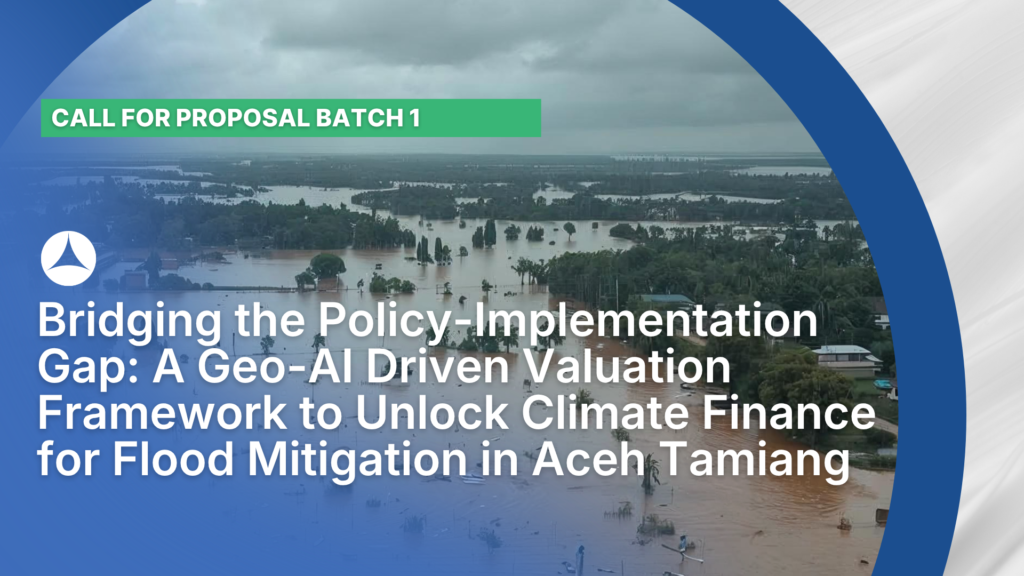
Bridging the Policy-Implementation Gap: A Geo-AI Driven Valuation Framework to Unlock Climate Finance for Flood Mitigation in Aceh Tamiang