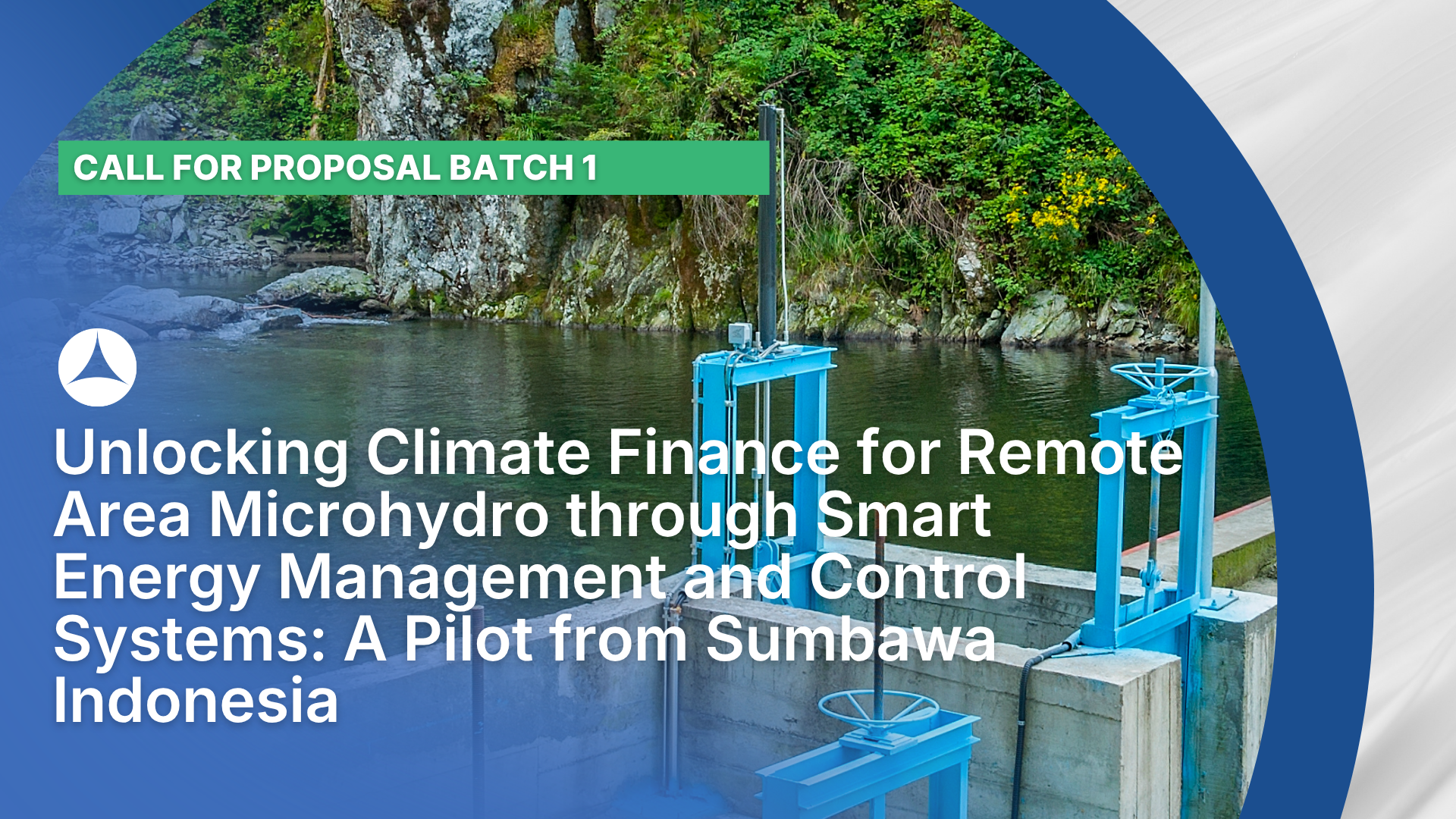
Unlocking Climate Finance for Remote Area Microhydro through Smart Energy Management and Control Systems: A Pilot from Sumbawa Indonesia
Ringkasan Eksekutif
“This study proposes the deployment and evaluation of MHGenC-EMS (Modular Hydro Generation Controller – Energy Management System) as an innovative digital and financial-ready platform to strengthen the performance, transparency, and bankability of community-based micro-hydro power plants (PLTMH) in remote areas of Indonesia, using Tepal Village, Sumbawa Regency as a pilot site.
Although micro-hydro systems play a critical role in rural electrification, many operate below their potential due to unstable frequency, inefficient water use, lack of real-time monitoring, and absence of credible performance data. These weaknesses limit not only technical reliability, but also access to climate finance, public funding, and private investment. This research addresses these gaps by integrating adaptive control, digital energy monitoring, and data-driven performance tracking into a single operational platform.
The MHGenC-EMS will enable optimized turbine control, stable power quality, and continuous digital recording of energy production and system performance. This creates a transparent and auditable dataset that can be used to demonstrate operational reliability, renewable energy output, and financial viability—key requirements for accessing climate finance instruments, blended finance, and results-based funding mechanisms.
The study adopts a mixed-methods approach, combining technical performance analysis, digital energy data, community-level energy use surveys, and stakeholder consultations. It also applies Gender Equality and Socio-Economic Inclusion (GESEI) principles to ensure that improved electricity access benefits women, low-income households, and small enterprises equitably.
By linking digital energy management with climate-finance readiness, this project will produce a replicable model of “climate-finance-ready micro-hydro” that aligns local renewable energy systems with Indonesia’s energy transition and decarbonization goals. The results will provide policy-relevant evidence for scaling community-based renewable energy through innovative, data-driven climate finance pathways”
Tujuan
Demonstrate how MHGenC-EMS–based monitoring, adaptive control, and data analytics can improve the technical reliability and financial transparency of community-based micro hydro power plant;
Develop a digital Measurement, Reporting, and Verification (MRV) framework for energy performance and carbon emission reductions of micro hydro power plant in remote areas;
Design innovative financing pathways that link community micro hydro power plant with national climate funds, carbon markets, and international financing mechanisms.
Komposisi Tim
Mukhtar Hadi, S.T. M.T
Universitas Teknologi Sumbawa
Afrianto, S.T., M.T
Universitas Teknologi Sumbawa
Mietra Aggara, S.T., M.T
Universitas Teknologi Sumbawa
Hanifa Sri Nuryani, M.M.
Universitas Teknologi Sumbawa
Imam Syaukani, M.Eng.
Universitas Teknologi Sumbawa
Publikasi Terkait

Unlocking the Value of Carbon Credits in Indonesia’s Geothermal Projects
Risk Mapping CCS/CCUS Value Chain in Indonesia: Guideline for Enhancing Bankability in Emerging Economies

De-risking Green Hydrogen and Ammonia Projects in Indonesia: A Risk-Based Approach to Innovative Climate Finance and Policy Design