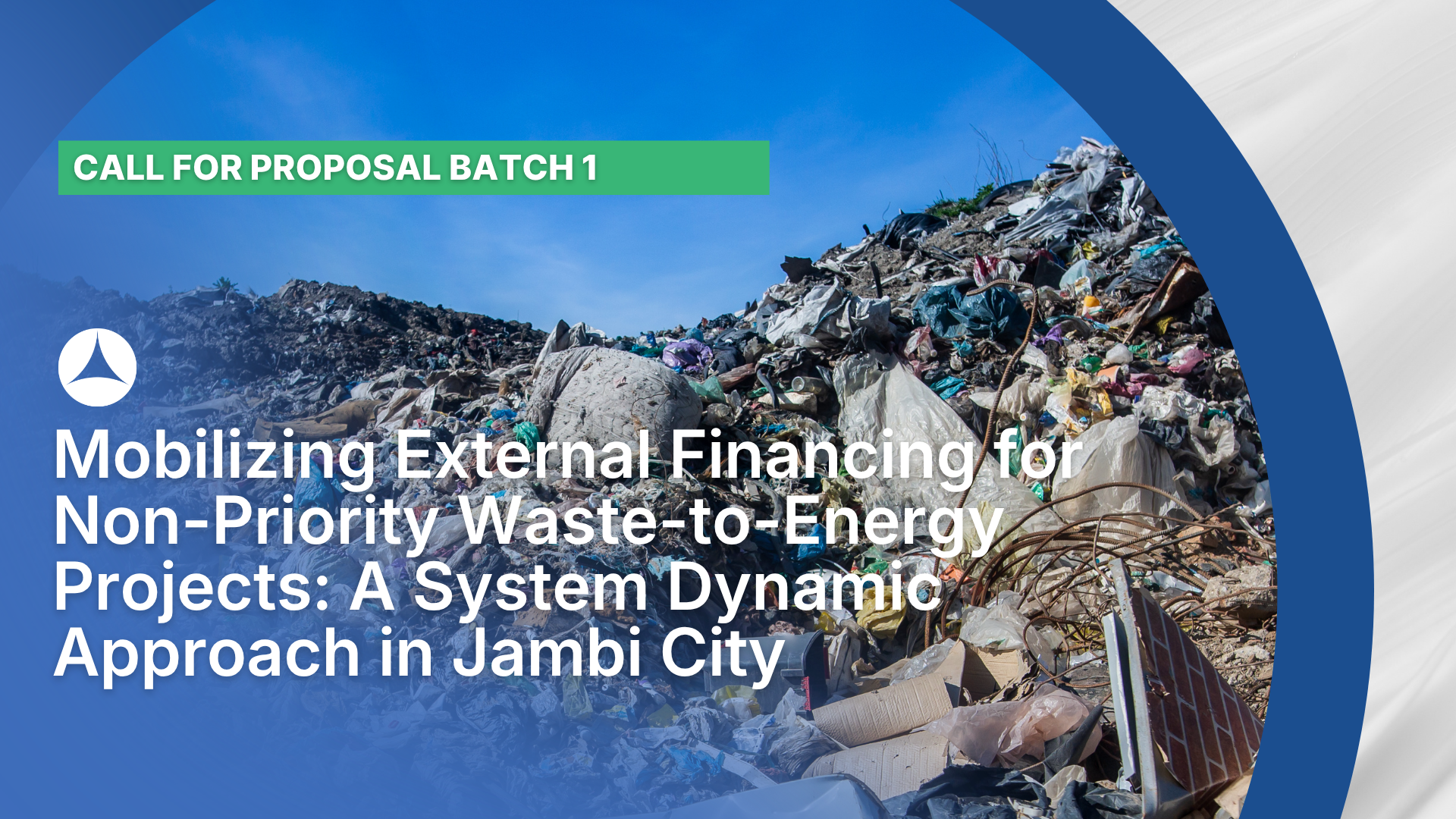
Mobilizing External Financing for Non-Priority Waste-to-Energy Projects: A System Dynamic Approach in Jambi City
Ringkasan Eksekutif
“Jambi City, a rapidly growing urban center with a population of approximately 622,000, generates an estimated 363.87 tons of municipal solid waste (MSW) per day. This volume places increasing pressure on existing landfill-based waste management systems and poses long-term environmental and fiscal risks for the city. Waste-to-Energy (WtE) technology offers a potential dual solution by reducing landfill dependence while producing renewable electricity. Based on current waste generation levels, Jambi’s MSW stream indicates a theoretical electricity generation potential of up to 21.69 MW. However, despite this technical feasibility, WtE development in Jambi remains financially constrained. Under Presidential Regulation No. 35/2018, WtE deployment in Indonesia was supported through geographically targeted federal tipping fee subsidies of up to IDR 500,000 per ton, but only for twelve designated priority cities. As Jambi was excluded from this list, any proposed WtE project has faced a persistent viability gap that undermines project bankability and investor confidence. This challenge is not unique to Jambi, but reflects a broader structural problem encountered by medium-sized, non-priority (“Tier 2”) cities across Indonesia. The enactment of Presidential Regulation No. 109/2025 marks a fundamental shift in Indonesia’s WtE policy framework. While the regulation removes geographical restrictions and formally allows participation by all cities, it simultaneously eliminates federal tipping fee subsidies, replacing them with a universal electricity tariff mechanism. This policy transition reallocates financial risk away from the central government and toward local governments and project developers. Whether tariff-based incentives alone can sustain WtE investment in Tier 2 cities remains an unresolved empirical and policy question.
From a research perspective, the transition from Presidential Regulation No. 35/2018 to No. 109/2025 constitutes a natural experiment. It enables systematic analysis of the financial consequences of shifting from a geographically targeted, subsidy-driven regime to a universal, tariff-based incentive model. This study proposes the development of a System Dynamics Model (SDM) to evaluate and engineer a financially viable WtE framework for Tier 2 Indonesian cities, using Jambi City as a representative case. The proposed SDM will simulate dynamic interactions between regulatory constraints (including electricity tariff differentiation for plants exceeding 20 MW capacity), waste generation trajectories, and alternative financing structures. Particular attention will be given to capacity optimization decisions and their implications for revenue stability, capital expenditure, and long-term project viability under the post-2025 regulatory environment. Crucially, the research will assess the role of blended finance mechanisms as substitutes for federal tipping fee subsidies. By modeling financing structures that combine private equity, green bonds, and regional government (APBD) contributions, the study aims to demonstrate how innovative capital stacking can reduce the cost of capital and restore investment attractiveness. The expected outcome is a validated, investment-oriented financial roadmap for a Jambi WtE facility, alongside a scalable policy template that can be replicated by other non-priority cities across Indonesia. In doing so, the study contributes empirically grounded evidence to national debates on WtE policy design, subnational infrastructure finance, and just energy transitions in emerging economies.”
Tujuan
To generate a scalable financial and policy framework applicable to other Tier 2 cities facing similar regulatory and fiscal constraints.
Komposisi Tim
Dr. Ir. Arsegianto, M.Sc.
ITB
Rahmadita Maharani, SST, M.B.A
ITB
Zartikazahra Nurulfiqri, M.B.A.
ITB
Publikasi Terkait
Unlocking the Value of Carbon Credits in Indonesia’s Geothermal Projects
Risk Mapping CCS/CCUS Value Chain in Indonesia: Guideline for Enhancing Bankability in Emerging Economies
De-risking Green Hydrogen and Ammonia Projects in Indonesia: A Risk-Based Approach to Innovative Climate Finance and Policy Design