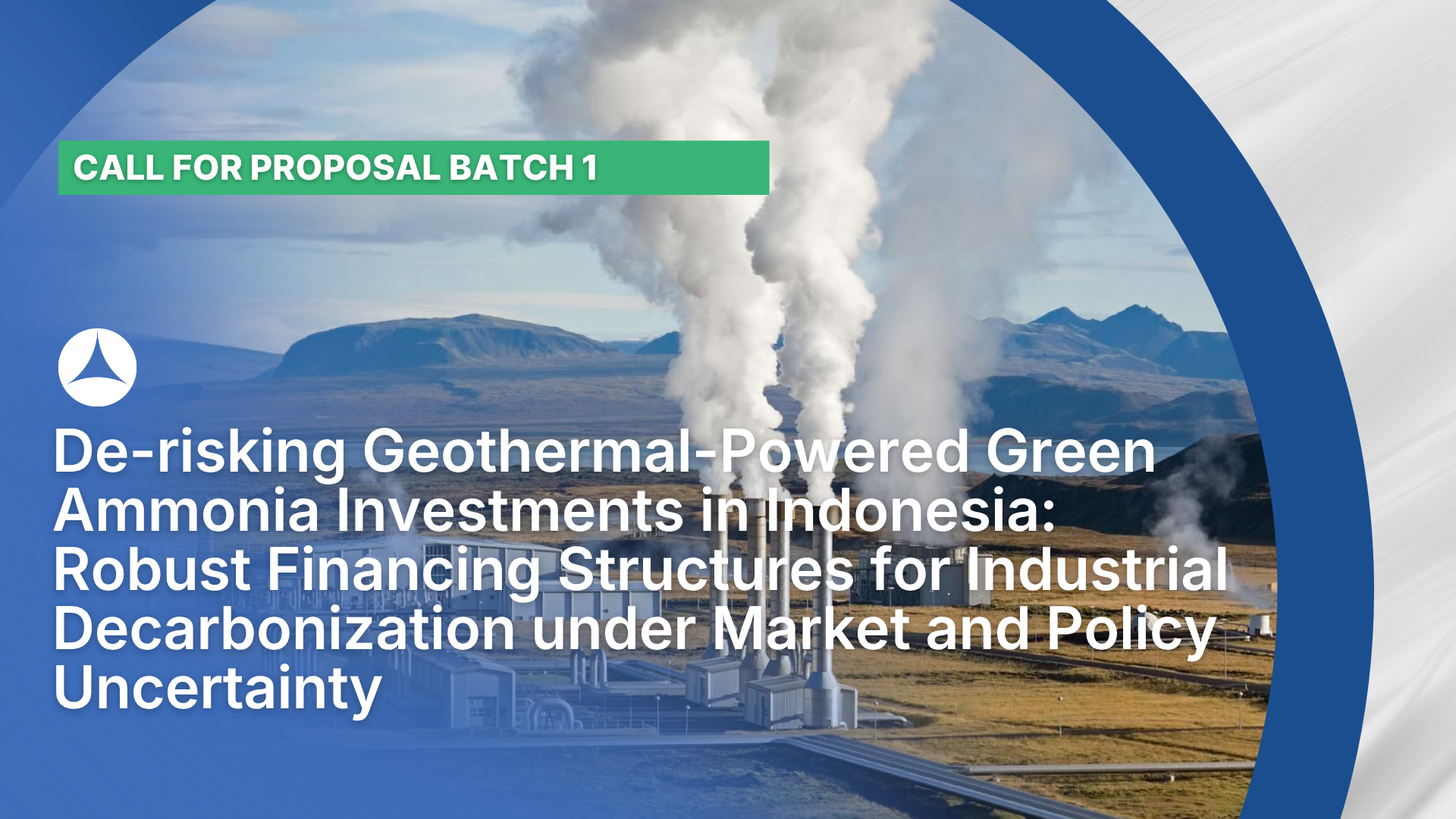
De-risking Geothermal-Powered Green Ammonia Investments in Indonesia: Robust Financing Structures for Industrial Decarbonization under Market and Policy Uncertainty
Ringkasan Eksekutif
“Indonesia’s commitment to achieving net-zero emissions by 2060 heightens the importance of developing low-emission, competitive solutions for energy-intensive sectors. Green ammonia presents a promising decarbonization option, especially for fertilizer manufacturing. Indonesia’s extensive geothermal resources provide a strategic advantage due to their high capacity factors and ability to supply baseload power. However, investment in geothermal-based green ammonia remains limited, primarily due to compounded risks arising from geothermal resource uncertainty and the still-developing green ammonia market.
This study addresses significant gaps within the scholarly literature by presenting the inaugural Exploratory Financial Modeling and Analysis (EFMA) of financing for geothermal-powered green ammonia projects in Indonesia. Prior research has predominantly focused on intermittent renewable energy sources, analyzed ammonia initiatives in isolation, and relied on deterministic or limited-probability methods that insufficiently account for market and policy uncertainties. Conversely, this investigation explicitly assesses the financial feasibility and bankability of integrated geothermal–green ammonia projects under deep uncertainty.
Utilizing a project-level discounted cash flow model in conjunction with exploratory modeling and scenario discovery techniques, this study examines a 55 MW geothermal-powered green ammonia case. Key uncertainties encompass geothermal resource performance, electrolyzer costs, ammonia prices, financing structures, and policy conditions. The analysis assesses how alternative methods of capital stacking, debt–equity configurations, and risk-sharing mechanisms impact the robustness of investments across various future scenarios.
The study aims to deliver policy-relevant insights concerning robust financing strategies, support climate finance mobilization under Indonesia’s Just Energy Transition Partnership, and establish a structured framework for de-risking investments in geothermal-powered green ammonia. By emphasizing financing over technology readiness alone, the research offers practical guidance to expedite industrial decarbonization by leveraging Indonesia’s geothermal resources.”
Tujuan
To identify key financial and structural uncertainties influencing investment decisions, including how geothermal resource risks interact with green ammonia market risks
To evaluate how different financing structures—such as changes in capital stacking, debt–equity ratios, and risk-sharing mechanisms—impact project bankability under uncertainty
To generate policy-relevant insights on financing setups resilient across various possible futures.
Komposisi Tim
Dr. Andri Dwi Setiawan
Universitas Indonesia
Dr. Marmelia Puja Dewi
Pertamina Geothermal Energy
Dr. Bramka Arga Jafino
World Bank
Dendy Rio Casillas Pratama, S.T., M.T.
Universitas Indonesia
Publikasi Terkait
Unlocking the Value of Carbon Credits in Indonesia’s Geothermal Projects
Risk Mapping CCS/CCUS Value Chain in Indonesia: Guideline for Enhancing Bankability in Emerging Economies
De-risking Green Hydrogen and Ammonia Projects in Indonesia: A Risk-Based Approach to Innovative Climate Finance and Policy Design