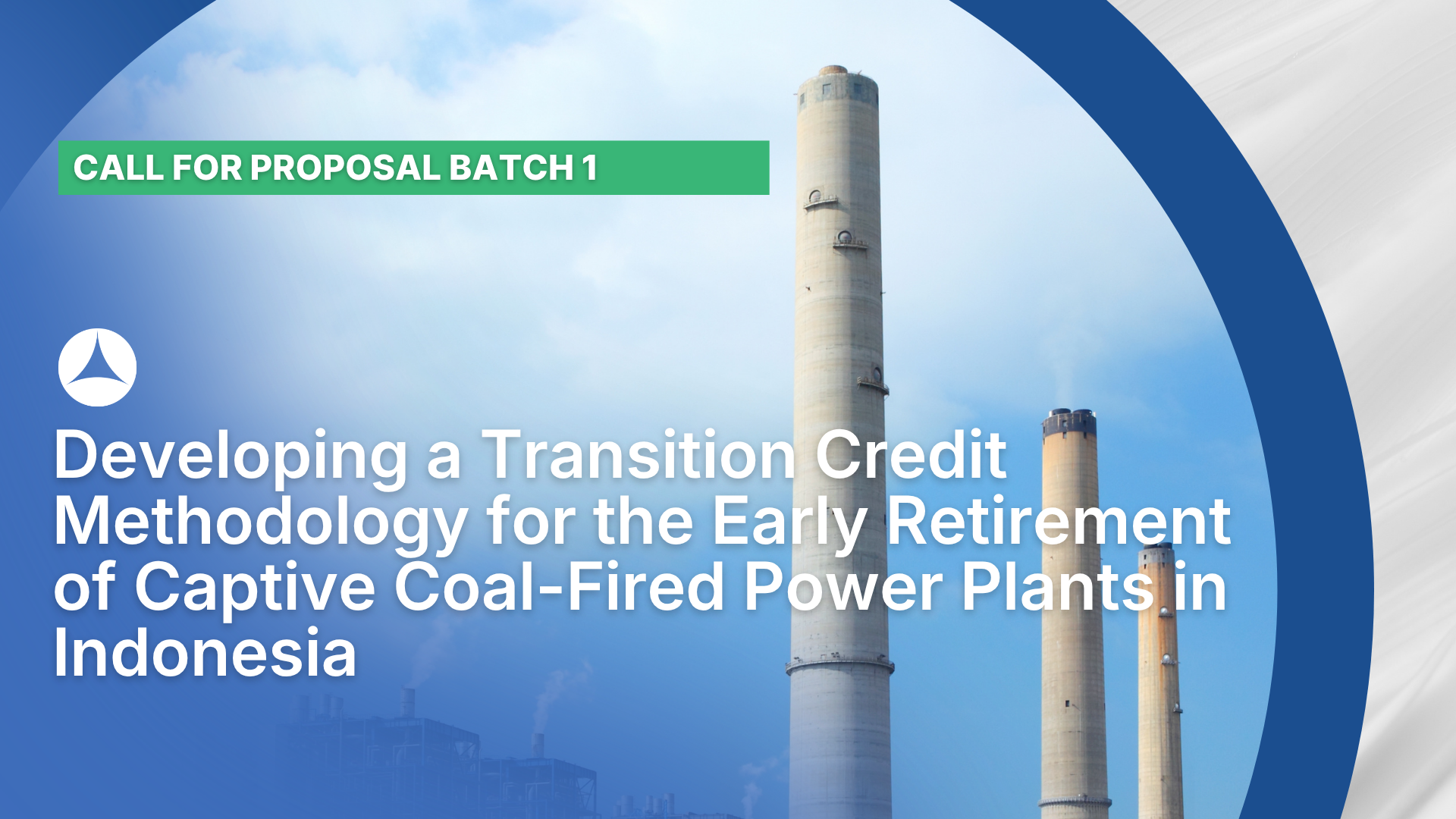
Developing a Transition Credit Methodology for the Early Retirement of Captive Coal-Fired Power Plants in Indonesia
Ringkasan Eksekutif
“Global warming has already reached about 1.1°C above the 1850–1900 baseline, and the physical science basis is unequivocal: human-caused greenhouse gas (GHG) emissions are the dominant driver of this warming [1]. The World Meteorological Organization (WMO) reports that, in 2024, globally averaged CO2 reached about 423.9 parts per million (ppm), roughly 52 percent above pre-industrial levels, while methane (CH4) and nitrous oxide (N2O) also reached new records (about 1,942 parts per billion and 338.0 parts per billion, respectively). [2]. CO2 remains the largest contributor to the radiative forcing from long-lived greenhouse gases, and continued growth in all three gases signals that both energy and land-system transitions remain insufficiently fast. The International Energy Agency (IEA) estimates energy-related CO2 emissions reached a record 37.4 Gt in 2023, with coal responsible for more than 65 percent of the year-on-year increase [3]. Even with the rise of renewable energy, coal still determines the short-term trajectory of global energy-based emissions.
In the past, Indonesia’s growth story has been powered by fossil fuels, and increasingly by coal. IEA notes that Indonesia’s total energy supply expanded by more than one-and-a-half times between 2000 and 2021, while coal’s share surged from less than 10 percent (2000) to almost one-third (2021), overtaking oil as the largest component in total energy supply. In other words: the economy is not only emitting more in absolute terms as it grows; its energy mix has also become more emissions-intensive because coal has gained a larger structural role [4]. This shows clearly in the emissions trend. The IEA estimates Indonesia’s energy-sector carbon dioxide (CO₂) emissions reached about 600 million metric tons (Mt) in 2021 and had more than doubled over the prior two decades [5].
According to a 2025 Reuters report on JETP, Indonesia’s captive-power capacity reached 25.9 GW in 2024, with over 75 percent coal-based and another 11 GW under development [6]. Despite more ambitious renewable energy policies, carbon intensity continues to rise due to new industrial and off-grid coal consumption. The JETP CIPP describes captive coal capacity as concentrated in Sulawesi and the Maluku Islands, reflecting the location of nickel resources and the scale of downstream processing, with smaller shares in Java and Sumatra. In Java, captive coal is linked more to pulp and paper and chemical production; in Sumatra, to pulp and paper and palm oil processing. Primarily, these off-grid captive plants exist to supply high-load-factors, always-on industrial demand, especially smelters and metals processing associated with the nickel downstream push. [7]
Nickel processing growth in remote industrial estates has been a major driver of captive power, which in Indonesia remains dominated by coal. If the investment and policy shift does not materialize, nickel downstreaming is likely to continue pulling additional captive coal-fired power plants into the system. Replacing captive coal with renewable energy would require not only new generation capacity but also electrification of heat processes, grid reinforcement, or alternative technologies that are not yet commercially viable at scale. If it does materialize, the competitive frontier for Indonesian nickel shifts as future capacity will increasingly be judged not only on delivered cost per ton, but on delivered emissions per ton.
This project builds directly on a previous study that examined the policy, regulatory, and feasibility dimensions of transition credits in Indonesia. As a continuation, the proposed research shifts focus from feasibility assessment toward the development of a concrete transition credit methodology applicable to captive CFPPs, while ensuring alignment with Indonesia’s institutional and carbon market context. The project responds to a clear gap: existing transition credit methodologies have been designed primarily for grid-connected power plants and do not adequately capture the operational, regulatory, and emissions-accounting realities of captive power.
The primary objective of the project is to develop a draft transition credit methodology for captive CFPP early retirement. The methodology will adapt and extend existing transition credit frameworks to address key issues such as eligibility and plant classification, baseline and counterfactual definition, additionality, monitoring and reporting boundaries, treatment of replacement power, and management of leakage and durability risks. Environmental integrity and alignment with international best practice will be central design principles. The project will ensure institutional and governance alignment by examining how the proposed methodology interacts with Indonesia’s electricity regulation, carbon market administration, national registry system, and emissions trading system (ETS).
The research will employ a qualitative, technical–institutional approach, combining structured consultations with Indonesian institutions, collaboration with international methodology developers, and expert review. Methodological rigor will be ensured through structured engagement, triangulation of sources, and transparent documentation of assumptions and design decisions.
The expected outcome is a technically robust, integrity-aligned draft methodology for transition credits applicable to captive CFPPs in Indonesia, supported by clear institutional grounding. The project delivers a concrete methodological instrument that can inform further consultation, refinement, and potential adoption by international standards or domestic authorities. By addressing a critical methodological gap, the project contributes to more credible consideration of transition credits as part of Indonesia’s broader strategy to manage industrial emissions and advance the energy transition.”
Tujuan
To develop a draft transition credit methodology for captive CFPP early retirement.
Komposisi Tim
Agus Sari
Landscape Indonesia
Michael Chang Kurniawan
Landscape Indonesia
Niken Pradonawati
Landscape Indonesia
Putri Agustina
Landscape Indonesia
Publikasi Terkait
Unlocking the Value of Carbon Credits in Indonesia’s Geothermal Projects
Risk Mapping CCS/CCUS Value Chain in Indonesia: Guideline for Enhancing Bankability in Emerging Economies
De-risking Green Hydrogen and Ammonia Projects in Indonesia: A Risk-Based Approach to Innovative Climate Finance and Policy Design